


Story time! Be warned: I’m going to make it interesting to read about the rules governing which jersey numbers college football players can wear during punts.
This is the situation: On a normal offensive play, five guys have to wear numbers between 50 and 79. These guys are called “offensive linemen,” and they stand next to each other. They are not eligible to go downfield to catch passes. This works fine for everyone. You don’t want most linemen catching passes.
It gets weird on kicks and punts, though. Special teams coaches like to have fast guys covering punts. Take Ohio State on this play in last year’s Playoff:
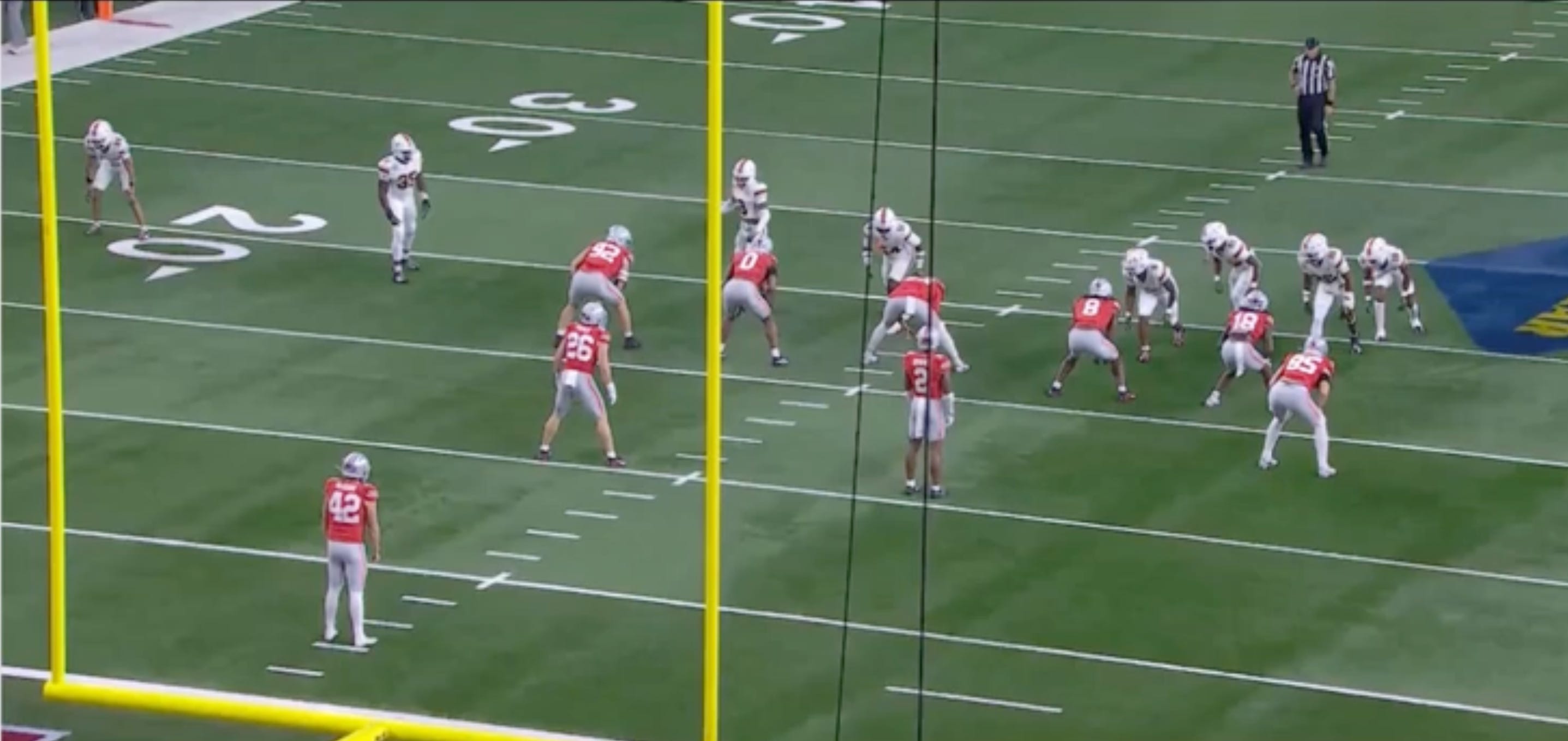
The Buckeyes could do that because of the “numbering exception,” which lets kicking and punting teams put non-linemen (i.e. guys not wearing numbers 50-79) in the central line positions. Like always, teams have to have seven men on the line, and of those guys, only the two on the ends of the line can run out to catch a pass in the event of a fake. But if you want to put fast coverage guys on the line, you can do it, and you don’t need to go through the hassle of getting a smaller No. 52 jersey for some running back or safety.
Football coaches are creative geniuses, and sometimes also big assholes. So in the 2000s, some high school coaches figured out that if they lined up in scrimmage kick formations (i.e. with “kickers,” “punters,” or “holders” way off the line) on every play, they could confuse the defense about who was eligible. Nobody would wear 50 through 79, and players could line up a few steps off the line, and the defense would not know for sure who was eligible.
The high priests of high school ball outlawed the “A-11 offense” in 2009. But little remnants of it have lived on, as punting teams look for ways to keep the defense off balance. Ohio State was one of those teams, as the above formation became this:
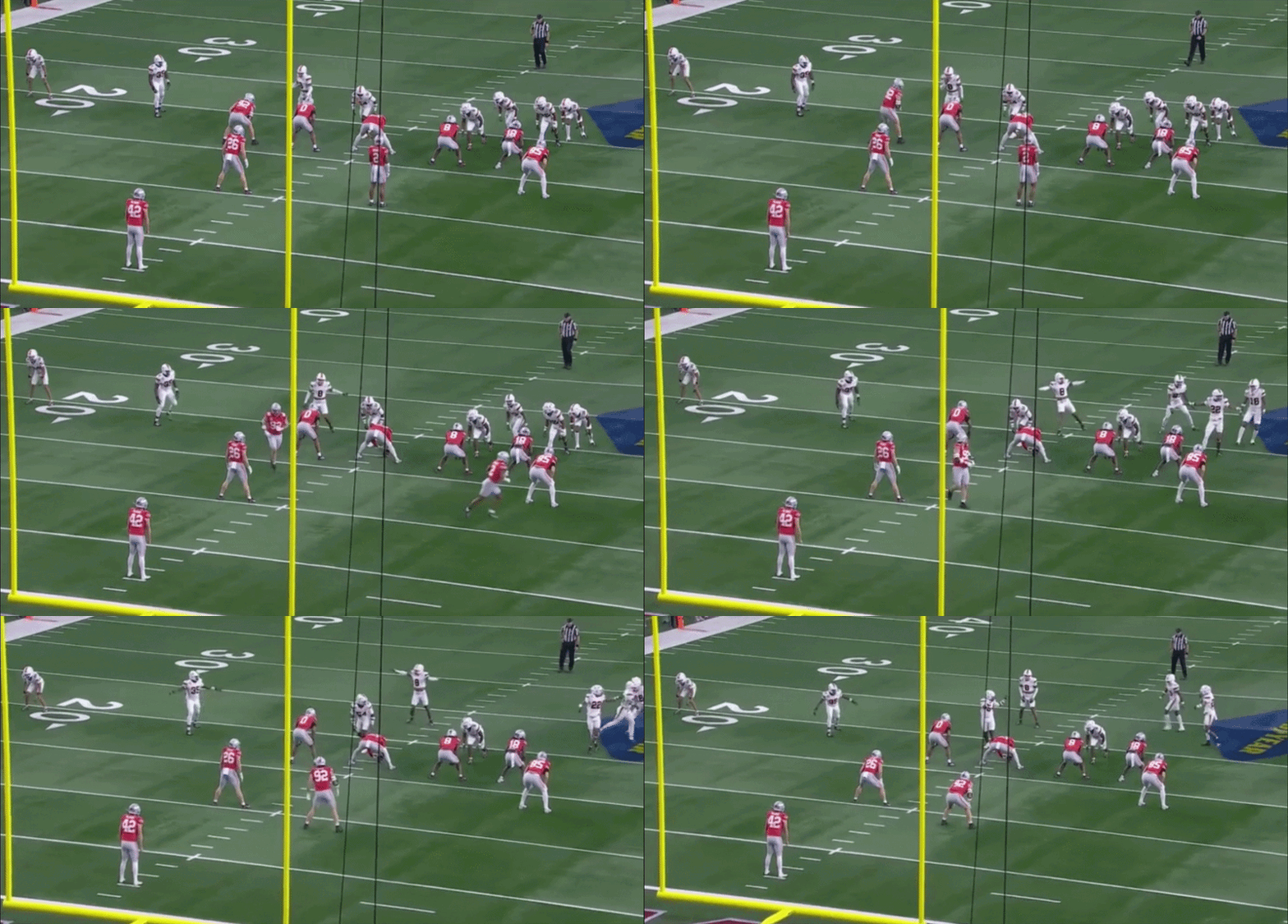
Oh no! What are they doing!?
Well, you can’t do that anymore. This year, the rule says this, with my bolding:
In a scrimmage kick formation at the snap (Rule 2-16-10) Team A may have fewer than five linemen numbered 50-79, subject to the following conditions:
The snapper and two adjacent linemen on either side of the snapper, not numbered 50-79 who are lined up in (or touching) the tackle box are ineligible receivers by position and become exceptions to the numbering rule when the snapper takes his position.
Any and all such numbering-exception players must be clearly on the line of scrimmage, and all backs must be clearly in the backfield. Otherwise, Team A commits a foul for illegal formation.
The football rules committee said the exception was creating confusion. Look at Miami’s players responding there, and you can see that they’re right.
Now, once the snapper takes his position over the ball, those four Ohio State players closest to the snapper are locked into their alignment, unless they’re wearing numbers 50 through 79. I’ve learned that special teams coaches in the South have asked the SEC’s officiating supervisor if they could circumvent this rule by having the snapper take his position after everyone else, and the league’s officiating supervisor told them that they could not. Sorry, coaches.
Our Southern pals are not alone. Coaches all over are angry about this, as a big handful explained to USA Today in April. Among other things, coaches predict:
Fewer fakes, because defenses won’t be as liable to get confused over who on the offense is allowed to go downfield. (The ref I asked doesn’t accept that this will be true, but concedes it’ll remove some creativity lanes.)
More blocked kicks and injuries to punters, because teams that want to cover punts with better athletes will now have to leave them in the middle of their formations no matter what and hope they can block.
There’s also, of course, the possibility of a lot of early-season illegal formation flags while coaches and players get comfortable with the new rules. Coaches might also object so furiously that the NCAA shelves the change, but it’s held firm on it all summer despite the uproar. (Kirk Ferentz, special teams connoisseur, believes the rule will lead to a “clown show.”)
Personally? I think fewer fakes sounds bad, but the idea of more blocked kicks is a thread worth pulling on. Punting teams could respond to that by simply putting bigger bodies (the ones wearing numbers 50 to 79) next to the snapper, but then those guys would have to cover down the field. That sounds fun! It also sounds like a fair conflict to throw coaches into: You can either have better coverage or more flexibility to move people around for fakes. Pick one!
If you liked this, subscribe free to get more CFB emails from us on Fridays. You don’t even have to be a paid subscriber to get them:
That’s a little column from Alex. Now here’s what to catch up on from a busy week at SZD.
Hector tagging in!
It’s time to preview the Big 12. Because we go in order of the standings, we start with the current main character of the conference, Texas Tech, and how the Red Raiders are starting to see the downsides to having one guy be at the forefront of everything. Then we talk about every other team, in detail.
Jessica Smetana joins to talk about Notre Dame for the independents and Pac-12 combined preview. She explains how CJ Carr could succeed after previously relying on a backfield that had two future first round NFL Draft picks. She also points out that Brian Kelly, who was seen visiting camp, might never get an in-stadium welcome unless most of the people in charge either leave or retire. Richard is surprised at this news.
We have a special Friday episode for subscribers. Alex is joined by host emeritus Godfrey to talk about what conference commissioners actually do. This is especially helpful now that we’re in the middle of media days.
Some recommended reading
For CBS Sports, Richard talked to current Stanford players about their attempt to unionize. The piece also includes the recent history of collegiate athletes attempting unionization.
In the last Sports Business Hour, Matt Brown talked about the tension between the business of jersey patches and football rivalries. He specifically mentioned that Ohio State would never allow a sponsor to put a splash of blue on its scarlet unis even if the company’s logo was blue. Well, he was right.
Elise Woodward is set to be the first female radio play-by-play announcer in FBS. She’ll be calling games for the Washington Huskies this upcoming season.
Thanks for watching our latest YouTube video
We dropped a video on how October 1, 2016 was one of the wildest days in college football. Based on all the comments on the video and throughout social, you all loved it. Is there another day in college football that is at that level? Let us know. Also, if you haven’t watched it yet, you can check it out right here.
Thanks for reading, and we’ll talk to you next week
This whole thing, and number rules in general, are antithetical to the game. All the rules governing formations and eligibility were devised and have been largely unchanged before numbers were ever introduced. The onus should be on the defensive team for identifying eligibility by correctly identifying line players. Shifts for non kicks should be governed by the same rules as kicks, because there’s no rule that says a “punting formation” is a punting formation. It’s just a formation from which people happen to punt mostly. This is just dumb. All a team has to do if they want to circumvent this is come out in a “non-kick” formation, do their shifting bullshit, and then drop back into a “kicking formation”, thus satisfying the numbering rules and avoiding violating the shifting rules.